
Research interests
My research can be loosely partitioned into three broad topics.
1. Pattern formation
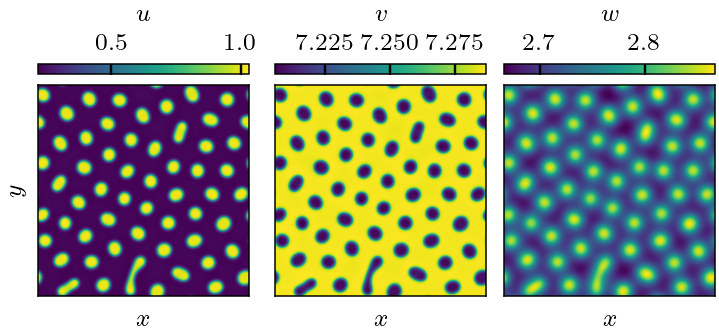
In recent years I have become interested in structure formation in biology. Since early 2022 I have been trying to understand biological condensates as active droplets formed by liquid-liquid phase separation. This work was made possible by an Alexander von Humboldt fellowship which allowed me to travel to Germany to collaborate with the Speck group.
I recently finished the first installment in this research program, which is available as a preprint. The focus of this work is on how reaction-diffusion equations of the form
\[\partial_t \vec\rho = \vec{R} + \mathbf{D} \nabla^2 \vec\rho\]produce patterns in the presence of conservation laws. My approach forges an explicit connection between Turing patterns and field theories in active matter, which were previously considered as distinct paradigms. In particular I have derived a universal limiting theory for pattern-formation in chemical systems that respect a conservation law. This limiting theory reduces to “Active Model B+”, a minimal active extension of the Cahn-Hilliard model, and describes pattern formation in a fully nonlinear fashion.
2. Aerosol science and disease transmission
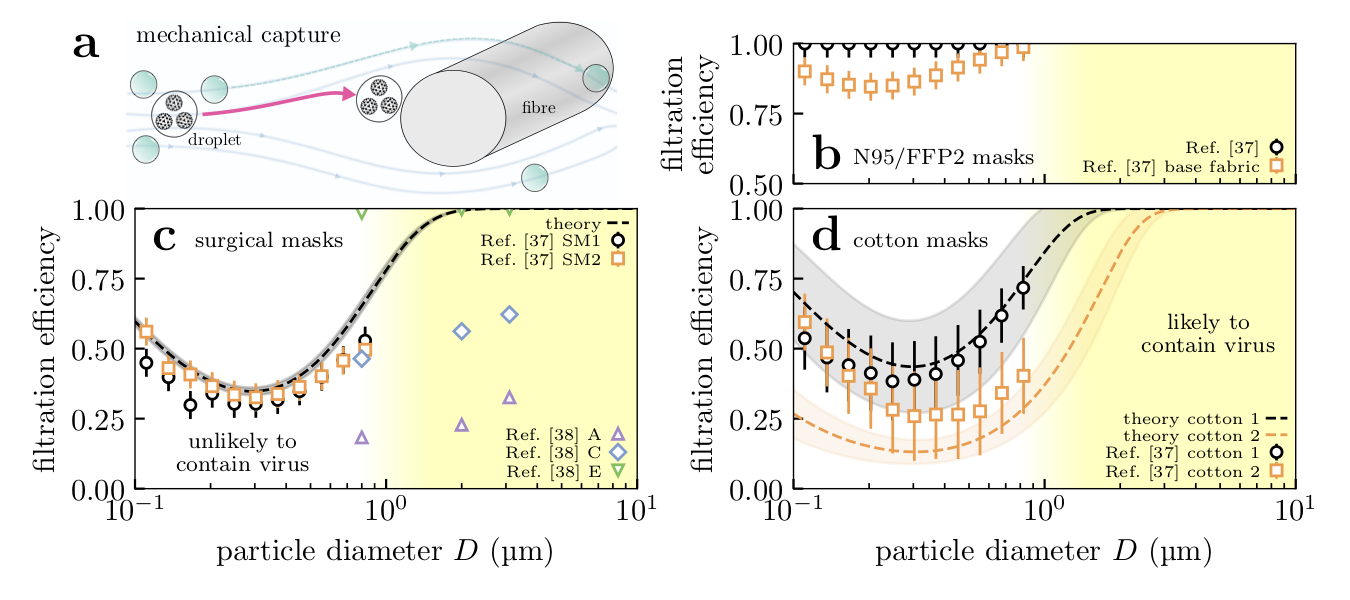
I frequently contribute theory to problems in aerosol science. This is normally motivated by experiments peformed by my collaborators at the Bristol Aerosol Research Centre. Previously I worked on the kinetics of aerosol droplets with applications to spray drying.
Following the start of the COVID-19 pandemic I became very interested in understanding to what extent face masks work at preventing disease transmission. The relevant physics at small (micron) length-scales turns out to behave very differently from what we experience at the macroscale, and poses some novel problems in fluid mechanics.
3. Liquid state theory and supercooled liquids
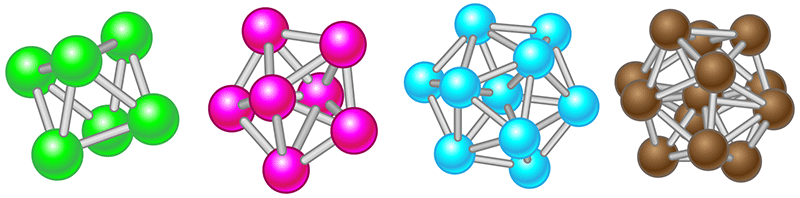
Liquids are notoriously hard to model. They are as dense as solids but lack any simplifying structure (e.g. the periodic symmetry of crystals). Liquid-state theory has traditionally been based on two-body correlation functions, which are generally assumed to capture the most important features of amorphous structure. I have worked on extensions of liquid state theory involving many-body correlations, i.e. accounting for amorphous arrangements of particles inside the liquid such as the clusters sketched above.
My interest in many-body correlations was originally motivated by supercooled liquids. In supercooled liquids the two-body measures change very little despite a dramatic 10+ orders of magnitude change in dynamical, so there appears to be a decoupling between structure and dynamics. However, if you look at higher-order measures of structure you do see a change in structure. An intriguing hypothesis is that structural features underlying dynamical arrest could be encoded in these subtle many-body correlations.
An accessible article about this work can be found in this viewpoint.